ASSESSMENT & REPORTING AT FHS

Spacer
Assessment is integral to teaching and learning in the classroom and is inextricably linked to the design of the curriculum. Effective assessment enables teachers to diagnose what students know and understand, identify gaps between what has been taught and what has been learned, and pinpoint common misconceptions. This wealth of data allows the teacher to provide the feedback and adaptive teaching required to move learning forwards, both during lessons and over time.
Spacer
Prior Attainment Data
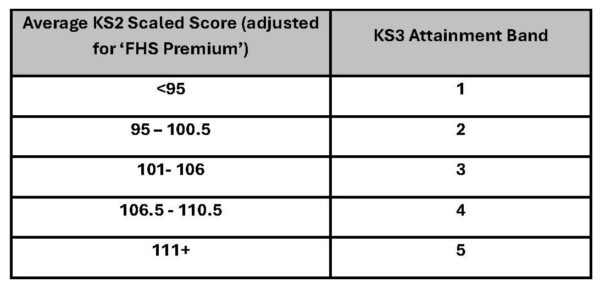
Key Stage Two (KS2) attainment data in reading and maths is used to allocate students to Attainment Bands, which set an estimated attainment pathway during Key Stage 3 (KS3). More detail about how this prior attainment data is used can be found in the KS3 and Key Stage 4 (KS4) sections below. All Year 7 students also take computer-based tests in reading, in addition to baseline classroom assessments in English and Mathematics early in their first term. This is used alongside the KS2 attainment data, to set students in English and Mathematics.
Spacer
Key Stage Three
All students are allocated to an Attainment Band based on their average scaled KS2 score (reading and maths combined), as follows:
Spacer
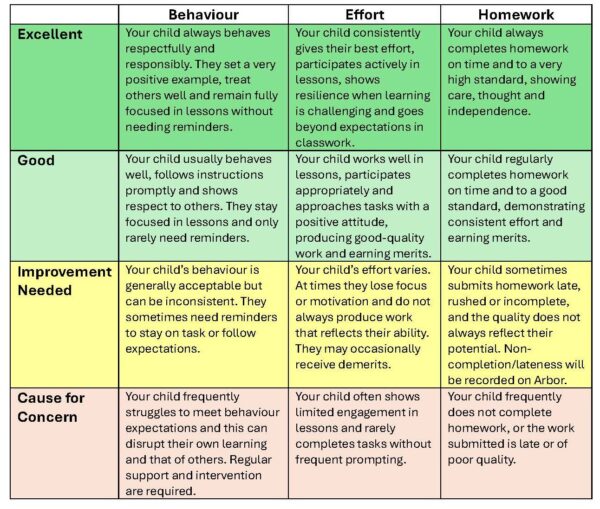
Throughout the year, each subject assesses students against the Assessed Curriculum Related Expectations (ACREs) through summative assessments that generate percentage scores, which are used to produce a rolling average attainment figure. This enables students to be ranked within their year group and placed into one of five attainment bands, providing a clear measure of progress relative to prior attainment and peers, and supporting targeted, data‑driven intervention by Curriculum Leaders and Heads of Year. Reports to parents include each student’s average KS2 score, their corresponding attainment band, and the band achieved in every subject, allowing progress to be judged against their starting point. This contextualises attainment in relation to prior ability—for example, a student entering in band 3 but achieving band 4 in most subjects is making better‑than‑expected progress. Reports also provide attitude to learning grades for effort, homework and behaviour (table below), along with attendance, merits and demerits, each compared with year‑group averages.
Spacer
At the end of each unit, students reflect on their progress towards the Assessed Curriculum Related Expectations using ACREs checklists, which they are encouraged to share with parents, so feedback is not limited to formal reporting windows. Alongside these checklists and the Progress Reports, parents can meet their child’s teachers once per year to discuss progress in more depth. KS3 students receive two Progress Reports annually.
Spacer
Key Stage Four
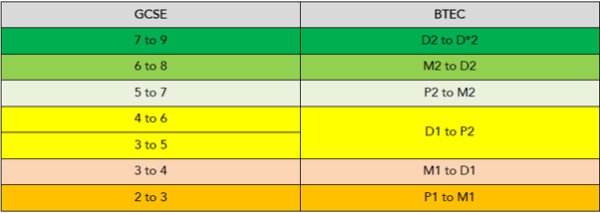
In Year 10, students are set aspirational end‑of‑KS4 achievement bands (table below) during the first half of the Autumn term, giving them a spread of target grades that both encourage ambition and ensure a positive Progress 8 contribution. These bands are based primarily on KS2 prior attainment, in line with Department for Education measures, but also draw on KS3 assessment data and staff knowledge of individual students, including input from the SENDCO. Bespoke bands are used where appropriate, such as for foundation‑tier subjects or non‑GCSE qualifications with alternative grading systems.
Spacer
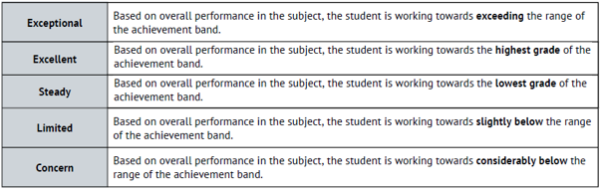
Alongside ongoing in‑class summative assessments, students complete at least one formal Pre‑Public Examination (PPE) per subject each year. KS4 students receive three progress reports annually, which include ‘Working At’ grades, which are point‑in‑time judgements based on performance in summative assessments and PPEs, rather than predictions – and Progress Indicators (table below) showing how well they are progressing towards their achievement bands. Following each PPE window, reports also include PPE grades. As with KS3, effort, homework and behaviour grades are provided for every subject, along with up‑to‑date attendance and merit/demerit information. Parents additionally have the opportunity to meet teachers once per year to discuss their child’s progress.
Spacer
Spacer
Key Stage Five
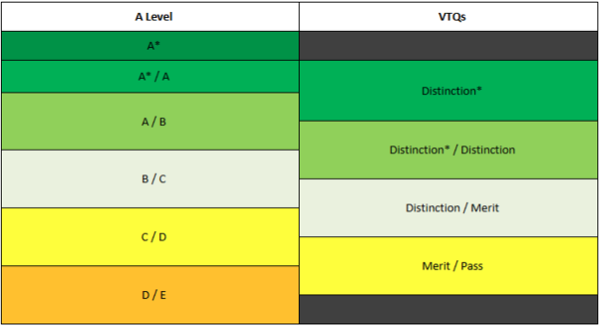
In the Sixth Form, students will also be set highly aspirational targets in the form of achievement bands. The targets will be set using GCSE average points scores at the end of Key Stage Four with the lower grade in the band challenging A Level and BTEC students to achieve grades that would return a positive ‘Value-Added’ judgement.
Spacer
Alongside ongoing in‑class summative assessments, students complete at least one formal Pre‑Public Examination (PPE) per subject each year. KS5 students receive three progress reports in Year 12 and two in Year 13. As with KS4, KS5 students receive ‘Working At’ grades and ‘Progress Indicators’ (table in KS4 section above) showing how well they are progressing towards their achievement bands. Following each PPE window, reports also include PPE grades. Similar to KS4, attitude to learning grades (for effort, behaviour and independent study) are provided for every subject, along with up‑to‑date attendance and merit/demerit information. Parents have the opportunity to meet teachers once per year to discuss their child’s progress.
Spacer
FHS Assessment & Achievement Policy
FORMBY HIGH SCHOOL

Spacer
Contact Us
Spacer
t: 01704 873100 / 877383
Spacer
Spacer
FORMBY HIGH SCHOOL
Freshfield Road
Formby
Liverpool
L37 3HW
Headteacher: Mr A Wood
twitter: @FormbyHigh
Spacer
Key Documents
Spacer
Spacer
If you require hard copies of anything on this website, please address your request to [email protected]